Mostrando entradas con la etiqueta John Quincy Adams. Mostrar todas las entradas
martes, 28 de agosto de 2012
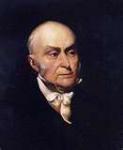
Biografia de John Quincy Adams
Sexto presidente de Estados Unidos (1825-1829)
Nació el 11 de julio de 1767 en Braintree, Massachusetts (Estados Unidos). Fue el hijo mayor del presidente John Adams, al que acompañó durante las negociaciones de paz que pusieron fin a la guerra de la Independencia estadounidense.
Cursó estudios en la Universidad de Harvard. Posteriormente abrió un despacho de abogados en Boston.
En 1793 fue nombrado por el presidente George Washington diplomático en Holanda y pasado algún tiempo le envió a Londres con el fin de que colaborara con John Jay en las negociaciones con Gran Bretaña, que culminaron en el llamado Tratado de Jay. En 1797 recibió el cargo de embajador en Prusia, con la que concluyó un pacto que incorporaba las cláusulas del Tratado de Jay.
En 1801 fue elegido para el Senado de Massachusetts y dos años después para el de Estados Unidos. En 1809 el presidente James Madison le nombró embajador en Rusia y en 1814 negoció en Gante el tratado que puso fin a la Guerra Anglo-estadounidense. Nuevamente fue nombrado diplomático en Gran Bretaña en 1815.
En el año 1817 fue nombrado por el presidente James Monroe secretario de Estado y obligó a España a ceder Florida, también modifica la frontera de Luisiana en el Tratado Transcontinental (Tratado Adams-Onís) firmado en 1819. El tratado con Francia se cerró en 1822 consiguiendo solamente una reducción gradual de la tarifa discriminatoria francesa.
En 1824 se vio involucrado en una dura competencia electoral para la presidencia. Efectuadas las votaciones, el candidato que recibió más sufragios fue con cierta diferencia Andrew Jackson, seguido en este orden, por J. Q. Adams, William H. Crawford y Henry Clay. El hecho de que ninguno contara con la mayoría y de que el ordenamiento jurídico no contemplara la posibilidad de mecanismos como el de la segunda vuelta, determinaron que el Senado tuviera que adoptar una decisión al respecto. Lo que entonces se produjo fue el apoyo de Clay a la candidatura de Adams. El favor de Clay fue pagado mediante un nombramiento de secretario de Estado en el gabinete de Adams, lo que ocasionó aceradas críticas al nuevo presidente.
Su mandato sufrió la hostilidad de los defensores de Jackson y Crawford en el Congreso, que le impidieron ejecutar el programa nacionalista que había concebido. Sus propuestas para crear un ministerio del Interior fueron rechazadas aunque consiguió que se designaran delegados al congreso de las naciones americanas convocado por Simón Bolívar en Panamá (1826). Firmó la tarifa de 1828 que protegía la producción lanera del norte, perjudicando así al sur. Se negó a usar el patrocinio federal para reforzar el apoyo de su partido, permitiendo que el director general de correos designara a defensores de Jackson.
En las elecciones de 1828, acusado de favorecer los intereses de la aristocracia, fue vencido por Jackson. Dos años después de que concluyera su mandato presidencial, regresa a la política ingresando en la Cámara de Representantes. Teóricamente era un whig, pero siguió manteniendo una postura política independiente. A partir de 1835 se identificó con los movimientos antiesclavistas, aunque no con los abolicionistas.
El 21 de febrero de 1848, John Quincy Adams sufrió un ataque de apoplejía en la Cámara y murió dos días después sin haber recuperado la consciencia. Fue enterrado al igual que su padre, madre, y esposa, en la Primera Iglesia Parroquial en Quincy.
John Quincy Adams Biography
The first President who was the son of a President, John Quincy Adams in many respects paralleled the career as well as the temperament and viewpoints of his illustrious father. Born in Braintree, Massachusetts, in 1767, he watched the Battle of Bunker Hill from the top of Penn's Hill above the family farm. As secretary to his father in Europe, he became an accomplished linguist and assiduous diarist.
After graduating from Harvard College, he became a lawyer. At age 26 he was appointed Minister to the Netherlands, then promoted to the Berlin Legation. In 1802 he was elected to the United States Senate. Six years later President Madison appointed him Minister to Russia.
Serving under President Monroe, Adams was one of America's great Secretaries of State, arranging with England for the joint occupation of the Oregon country, obtaining from Spain the cession of the Floridas, and formulating with the President the Monroe Doctrine.
In the political tradition of the early 19th century, Adams as Secretary of State was considered the political heir to the Presidency. But the old ways of choosing a President were giving way in 1824 before the clamor for a popular choice.
Within the one and only party--the Republican--sectionalism and factionalism were developing, and each section put up its own candidate for the Presidency. Adams, the candidate of the North, fell behind Gen. Andrew Jackson in both popular and electoral votes, but received more than William H. Crawford and Henry Clay. Since no candidate had a majority of electoral votes, the election was decided among the top three by the House of Representatives. Clay, who favored a program similar to that of Adams, threw his crucial support in the House to the New Englander.
Upon becoming President, Adams appointed Clay as Secretary of State. Jackson and his angry followers charged that a "corrupt bargain" had taken place and immediately began their campaign to wrest the Presidency from Adams in 1828.
Well aware that he would face hostility in Congress, Adams nevertheless proclaimed in his first Annual Message a spectacular national program. He proposed that the Federal Government bring the sections together with a network of highways and canals, and that it develop and conserve the public domain, using funds from the sale of public lands. In 1828, he broke ground for the 185-mile C & 0 Canal.
Adams also urged the United States to take a lead in the development of the arts and sciences through the establishment of a national university, the financing of scientific expeditions, and the erection of an observatory. His critics declared such measures transcended constitutional limitations.
The campaign of 1828, in which his Jacksonian opponents charged him with corruption and public plunder, was an ordeal Adams did not easily bear. After his defeat he returned to Massachusetts, expecting to spend the remainder of his life enjoying his farm and his books.
Unexpectedly, in 1830, the Plymouth district elected him to the House of Representatives, and there for the remainder of his life he served as a powerful leader. Above all, he fought against circumscription of civil liberties.
In 1836 southern Congressmen passed a "gag rule" providing that the House automatically table petitions against slavery. Adams tirelessly fought the rule for eight years until finally he obtained its repeal.
In 1848, he collapsed on the floor of the House from a stroke and was carried to the Speaker's Room, where two days later he died. He was buried--as were his father, mother, and wife--at First Parish Church in Quincy. To the end, "Old Man Eloquent" had fought for what he considered right
Suscribirse a:
Entradas (Atom)

